Fort Reno: Guardian of the Capital
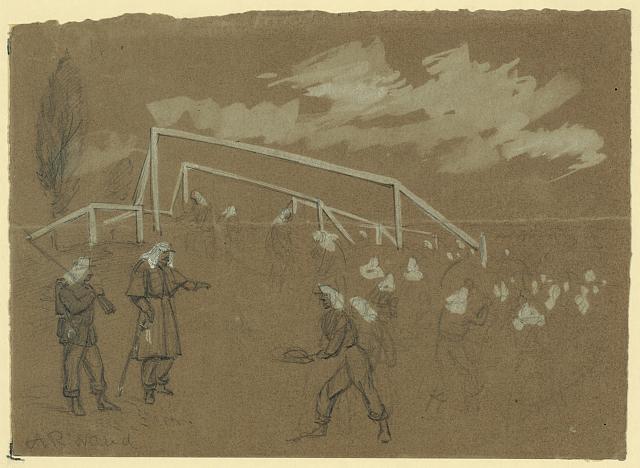 Troops breaking ground for a fortification to defend Washington, D.C., 1861. Library of Congress.
Fort Reno stands as one of the most historically significant sites in Washington, D.C., serving as both the highest natural point in the District and the location of a crucial Civil War fortification that helped save the nation's capital from Confederate attack.
Geographic Significance
The Highest Point in DC
- Elevation: 409 feet (125 m) above sea level
- This is the highest natural elevation in the District of Columbia
- For comparison: Most of Washington, D.C. sits around 20 feet above sea level
- Interestingly, the official height is about 20 feet lower than the artificial highpoint of approximately 429 feet in the area of the nearby reservoir
The Official Survey
The D.C. Association of Land Surveyors formally surveyed the area in 2007 and declared a new highpoint in a slightly different location than what was previously thought. A USGS Benchmark was placed at coordinates: 38.95198, -77.075922. The high point is marked by a small metal disk set into the ground.
Civil War History
Construction (1861)
In early August 1861, shortly after the disastrous Union defeat at the First Battle of Manassas (Bull Run), engineers in charge of the defenses of Washington identified the tall hill on the Dyer estate as a critical site for protecting against invasion.
Brigadier General John G. Barnard was tasked with building a series of defensive fortifications around Washington, D.C. This location was chosen because its higher elevation allowed the Union Army to protect the Rockville Pike—one of the critical routes into the capital city.
Original Name: Fort Pennsylvania
The fort was originally named Fort Pennsylvania and was constructed during the winter of 1861.
Renaming to Fort Reno
The structure was renamed Fort Reno in 1863 in honor of Major General Jesse Lee Reno, who died at the Battle of South Mountain in 1862.
The Dyer Estate
The land on which the fort was built belonged to the estate of Giles Dyer, a Treasury Department official who died in 1856. His wife Jane administered the estate at the time the land was seized for military purposes.
Military Strength
At its peak, Fort Reno was a formidable fortification: - A dozen heavy siege guns - A contingent of 3,000 men - The largest fort of those surrounding Washington - Supported by a large garrison of soldiers in Tenleytown
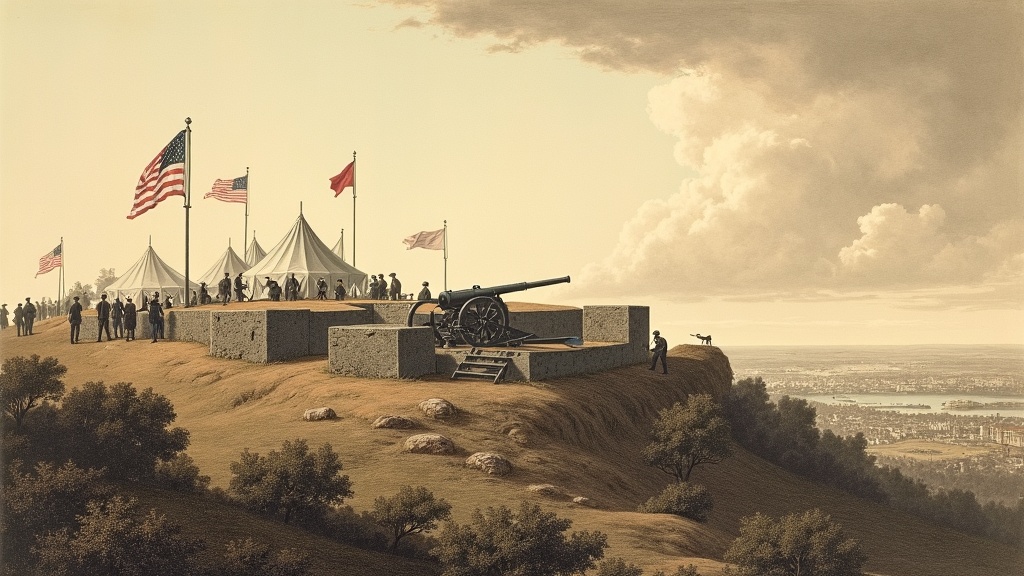 AI-generated artistic interpretation of Fort Reno's earthwork fortifications and artillery positions during the Civil War, circa 1864. Not a historical photograph.
Notable Garrison Members
The soldiers stationed at Fort Reno and in Tenleytown included future luminaries: - Walt Whitman (the poet, who served as a nurse) - Oliver Wendell Holmes Jr. (future Supreme Court Justice)
The Battle of Fort Stevens (July 1864)
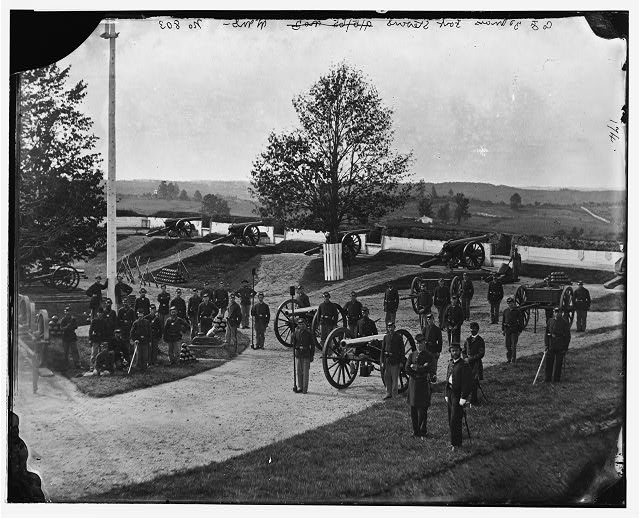 Officers and men of Company F, 3rd Massachusetts Heavy Artillery, at Fort Stevens, August 1865. Fort Stevens was the site of the only Civil War battle fought within D.C., where Fort Reno's artillery forced the Confederate advance to shift. Photo by William Morris Smith, Library of Congress.
Fort Reno played a crucial role in the only Civil War battle fought within the District of Columbia.
The Early Advance
Around noon on Monday, July 11, 1864, Fort Reno was the first of the defenses to view Confederate General Jubal Early's advance near Rockville, Maryland.
- Lookouts from the signal tower at Fort Reno saw clouds of dust
- They spotted Confederate army wagons moving toward the city
- This early warning was crucial to the capital's defense
Redirecting the Attack
Commanders directed Fort Reno to fire its large artillery on the approaching soldiers. The heavy bombardment caused the invading force to shift its assault 4 miles to the east across Rock Creek to Fort Stevens.
Had Fort Reno not been positioned at this high point and provided early warning, Washington, D.C. might have fallen to Confederate forces.
Post-War: Reno City (1866-1920s)
Decommissioning
In 1866, the fort was decommissioned and the land was returned to the Dyer family. The outbuildings and anything that could be sold was liquidated.
The Birth of an African American Community
After the war, a racially-mixed, mostly African American community called Reno City evolved on the site of the former fort.
The community had its roots in the Civil War, as Fort Reno became a magnet for: - Contrabands (escaped slaves) - Freed blacks - Enslaved people seeking a safe haven
Reno City at Its Height
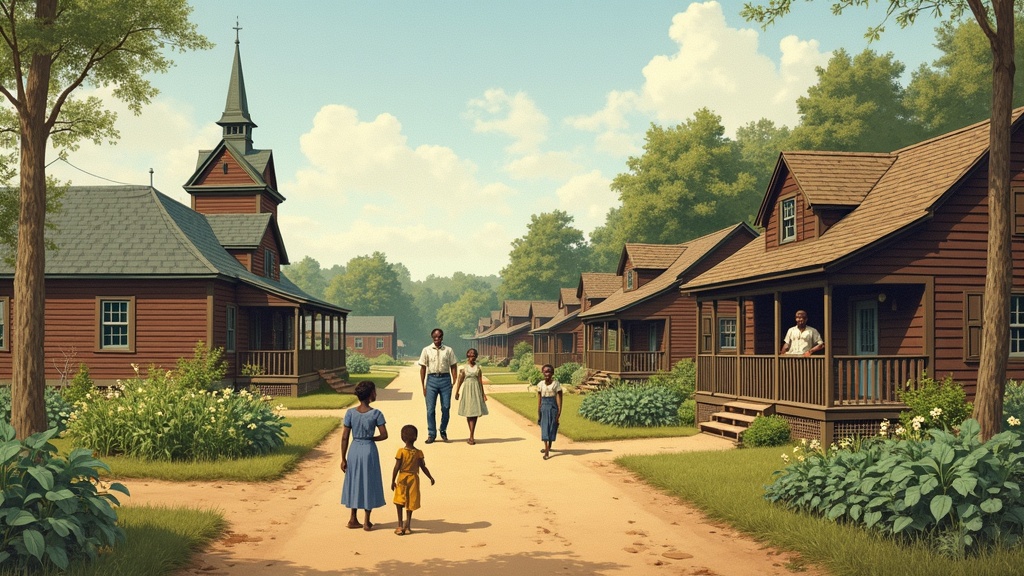 AI-generated artistic interpretation of Reno City, the African American community that thrived on the former fort grounds in the early 1900s. Not a historical photograph.
The community that developed included: - About 100 homes - Several stores - Churches - A fraternal lodge - The Jesse Reno School for African American children (constructed 1903)
Demographics
Reno City was about 75% Black and 25% white—a racially integrated neighborhood in a deeply segregated city.
The Destruction of Reno City (1920s)
Forced Removal
In the 1920s, a coalition worked together to remove Reno City: - Politicians - Developers - Residents of surrounding all-white, middle-class neighborhoods
With an influx of white, middle-class families moving to Tenleytown, the government decided that Reno City's land would be the best place to develop schools and a park for these incoming families.
Condemnation and Demolition
Despite protests from Reno City residents, the government: - Systematically condemned homes and businesses - Demolished African American-owned properties - Displaced the entire community
What Replaced Reno City
The cleared land was used for: - Fort Reno Reservoir complex - Alice Deal Junior High School (now Deal Middle School) - Woodrow Wilson High School athletic fields (now Jackson-Reed High School)
The Legacy
The Reno School building, constructed in 1903 for African American students, is one of the few remaining traces of this community. The deliberate destruction of Reno City represents one of the darker chapters in DC's history of racial discrimination.
Fort Reno Park Today
Ownership and Use
Most of the property is owned by the National Park Service, including: - A community garden - A former community center - Large expanses of grass - The historic high point marker
The Fort Reno Concert Series
Since 1968, Fort Reno Park has hosted a beloved free summer concert series.
Origins
The concerts began in the Summer of 1968 as part of the NPS "Summer in the Parks" initiative, designed to ease tensions following the assassination of Martin Luther King Jr. The program was specifically designed to bring under-served African American youth and diverse audiences into DC's parks.
Musical Evolution
- Initially featured local jazz, Latin, and dance bands
- The opening season in 1968 included groups like Paul Hawkins Latin Ensemble and the Trinidad Steel Band
- By the early 1970s, rock groups appeared
- Fort Reno became a hub for punk bands in the late '70s and early '80s
- The series has been particularly important to the local hardcore punk community
DC Punk and Hardcore at Fort Reno
Fort Reno became synonymous with the Washington, D.C. punk and hardcore scene, hosting legendary performances:
- Fugazi: The iconic DC post-hardcore band played multiple shows at Fort Reno, including memorable performances in 1997 and 2002
- Dischord Records bands: Many artists from the influential DC independent label performed at Fort Reno
- Dismemberment Plan: Another beloved DC band performed at the park
- Revolution Summer (1985): Fort Reno was part of the venues that hosted bands during this important period in DC punk history
- Positive Force: The activist collective helped organize many punk shows at the park
The connection between Fort Reno and DC punk is documented in resources like the zine "Punk at DC Area National Parks" available through the Internet Archive.
Volunteer-Run Tradition
The "Summer in the Parks" program was terminated in 1976, but the concert series lived on through volunteer organizers. It continues today with zero funding from the District of Columbia or the National Park Service.
Location
Fort Reno Park is located at 4000 Chesapeake Street NW, across the street from Jackson-Reed High School.
What Remains of the Fort
Most of Fort Reno could be seen as late as 1892, but: - The fort and battery at the north end were eventually graded down - The land was used for construction of a water reservoir - Little visible evidence of the original fortification remains today
However, the strategic significance of this highest point in Washington, D.C. is forever written into the history of how the nation's capital was saved from Confederate invasion.