Broadcasting History: Where Television Was Made
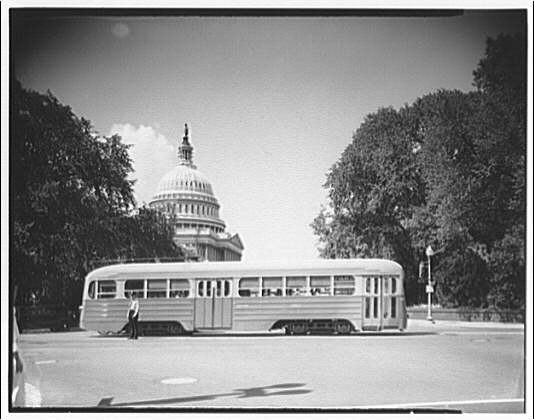 A streetcar passes the U.S. Capitol in the 1930s. Streetcars connected the Tenleytown studios to downtown Washington, enabling the rise of local broadcasting. Photo by Theodor Horydczak, Library of Congress.
Tenleytown holds a unique place in American broadcasting history. From the birth of the Muppets to presidential debates, the neighborhood's television studios have witnessed—and created—some of the most significant moments in media history.
WRC-TV: NBC4 Washington
The Station's Origins
WRC-TV (NBC4 Washington) traces its roots to experimental television station W3XNB, put on the air by the Radio Corporation of America (RCA), NBC's parent company, in 1939.
Key milestones: - June 27, 1947: Station launched as WNBW - October 18, 1954: Call letters changed to WRC-TV to align with co-owned AM and FM radio stations - First studio: A makeshift facility in the Wardman Park Hotel
The Tenleytown Studios
WRC-TV's primary studio facilities are located at 4001 Nebraska Avenue NW in Tenleytown, a site shared with sister station WZDC-CD (Telemundo 44).
The building was: - Constructed between 1956 and 1958 - Designed to consolidate NBC's Washington-area television and radio operations - A state-of-the-art facility for both broadcast production and transmission - Has served as the station's broadcast hub since 1958
Broadcast Firsts
WRC-TV pioneered several important television firsts: - First live coverage from Capitol Hill: The Marshall Plan hearings - Debut of Meet the Press: Still on the air as the first and longest-running public affairs show - 1949: Joined three other stations to broadcast a presidential inauguration for the first time
The Nixon-Kennedy Debate (1960)
The Second Presidential Debate
On Friday, October 7, 1960, the WRC-TV studios hosted the second presidential debate between Vice President Richard Nixon and Senator John F. Kennedy.
- Moderator: Frank McGee of NBC
- Panelists: Paul Niven, Edward P. Morgan, Alvin Spivak, and Harold R. Levy
- Viewership: More than 60 million viewers tuned in
The Thermostat Incident
Chris Matthews, whose news-talk series Hardball originated from the same studios for more than 20 years, recounted a famous behind-the-scenes moment:
"The Kennedy people came in before the second debate and saw that the room was freezing, like a meat locker. Kennedy's media advisor ran to the thermostat and discovered that a Nixon aide had turned the heat down because he didn't want his boss to sweat the way he had the first time around."
Historical Significance
The 1960 debates were: - The first televised presidential debates in U.S. history - Simulcast on all three networks - Revolutionary in demonstrating television's power in politics
Jim Henson and the Birth of the Muppets
Sam and Friends (1955-1961)
Perhaps no broadcast legacy is more beloved than the creation of the Muppets at WRC-TV.
Jim Henson began his television career while still a student: - 1954: While in high school, performed puppets on a local Washington, DC Saturday morning program on WTOP-TV - 1955: As a freshman at the University of Maryland, given his own twice-daily, five-minute show on WRC-TV
The Show
Sam and Friends aired live: - Dates: May 9, 1955 to December 15, 1961 - Format: Twice-daily, three-to-five-minute puppet show - Time: Weeknights as a local series - Format: Initially black and white, later color
The Birth of Kermit
Kermit the Frog made his debut on Sam and Friends: - Created by Henson in 1955 - The original puppet was made from: - A coat belonging to Henson's mother - A pair of Henson's blue jeans - A ping pong ball cut in half for the eyes - Originally described as a "lizard-like creature"—not referred to as a frog until a decade later
Innovation in Puppetry
Jim Henson made several important innovations in television puppetry: 1. Moving mouths: Did away with tiny one-hand puppets whose heads only bobbed when they talked 2. Real hands: Used puppets with moving mouths and often real hands 3. No stage: Got rid of the traditional stage that all puppets on TV hid behind
Jane Nebel: Co-Creator
Jane Nebel (later Jane Henson) joined Jim as a co-performer and creator on Sam and Friends. Together they: - Co-founded Muppets, Inc. (now The Jim Henson Company) in 1958 - Married in 1959
Legacy
"Even though it was only five minutes a day, it was a big part of the WRC promotion, and it won Jim Henson his first Emmy Award."
Of all the characters created for Sam and Friends, only Kermit would remain as a major figure with Jim Henson for later productions. He would go on to become one of the most recognized characters in entertainment history.
WJLA-TV (Formerly WMAL-TV)
Origins
The District of Columbia's third television station began broadcasting on October 3, 1947, as WMAL-TV, owned by the Washington Star.
Historic distinction: It was the first high-band VHF television station (channels 7-13) in the United States.
Network Affiliations
- January 1933: WMAL radio joined the NBC Blue Network
- The station remained with the network after it was spun off by NBC and evolved into ABC
- 1977: WMAL-TV separated from its radio siblings when ABC purchased WMAL radio
- June 6, 1977: Became WJLA-TV (after owner Joe Allbritton's initials)
Tenleytown Connection
WJLA-TV's transmitter is located in the Tenleytown neighborhood of Northwest Washington.
The Joy Boys
Tenleytown's broadcasting studios also hosted the Joy Boys, a popular radio comedy duo who entertained Washington audiences. Their show originated from the WRC studios, adding to the neighborhood's rich broadcasting heritage.
WWII: Women Codebreakers at Nebraska Avenue
While not technically broadcasting, another remarkable story unfolded nearby on Nebraska Avenue during World War II.
The Navy's "Bletchley Park"
In 1943, the Navy converted a seminary campus on Nebraska Avenue into a military intelligence headquarters. Women of the U.S. Navy's WAVES (Women Accepted for Volunteer Emergency Service) worked there breaking codes.
Breaking the German Code
Women assigned to OP-20-G, a codebreaking division within the Navy's Office of Communications: - Worked to unravel encrypted messages sent by German forces - Operated the Bombe machines: hulking masses of rotors and wires, each standing 7 feet tall and weighing around 5,000 pounds - Kept the machines running 24 hours a day
Impact
By the end of the war, 95 German U-boats were sunk or captured, in large part thanks to intelligence revealed by the WAVES of OP-20-G.
According to historian David Kohnen:
"The story of Nebraska Avenue is really yet to be told... in many respects we should consider Nebraska Avenue the US Navy's Bletchley Park."
A Broadcasting Legacy
Tenleytown's role in broadcasting history is unparalleled among Washington neighborhoods:
| Year | Event |
|---|---|
| 1947 | WRC-TV (WNBW) launches |
| 1947 | WMAL-TV begins broadcasting |
| 1949 | First televised presidential inauguration |
| 1955 | Sam and Friends debuts; Kermit the Frog introduced |
| 1958 | WRC-TV moves to Nebraska Avenue studios |
| 1960 | Nixon-Kennedy debate at WRC-TV |
| 1961 | Sam and Friends ends |
The studios at Nebraska Avenue continue to broadcast news and entertainment to the Washington region, carrying forward a tradition that began in the earliest days of television.