American University: A National Vision
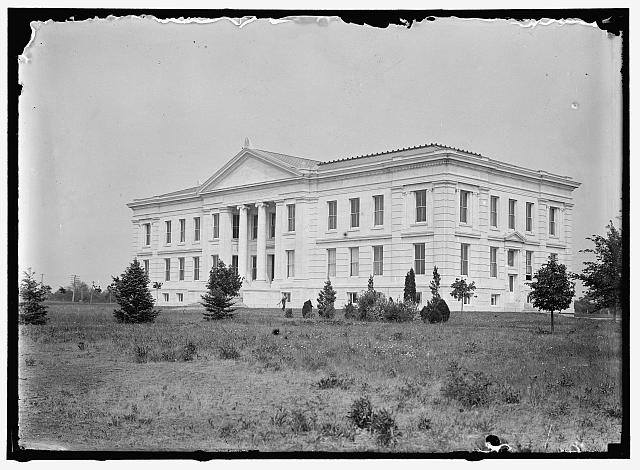 American University College Buildings, 1914. Photograph by Harris & Ewing. Library of Congress.
American University stands as one of the most significant institutions in Upper Northwest Washington, D.C., with a history that spans the founding vision of the nation's first president to its dark role in World War I chemical weapons development.
Founding Vision
Origin Story
American University was founded at the urging of Methodist bishop John Fletcher Hurst, who sought to create an institution that promoted: - Public service - Internationalism - Pragmatic idealism
The university was designed as an answer to George Washington's call to create a national university in the nation's capital, with a vision to train public servants for the future.
Charter and Incorporation
- 1891: Incorporated in the District of Columbia as a graduate school and research center with ties to the Methodist church
- February 1893: Chartered by an Act of Congress
- 1902: Ground broken for the campus
- 1914: Opened as a graduate education institution
- 1925: Admitted its first undergraduates
Early Students and Progress
The university was progressive for its time: - The first 28 students included five women—notable at a time before women could vote - In 1915, an African American student won a fellowship to pursue a doctorate
Campus Design
Frederick Law Olmsted's Vision
The initial 90-acre campus was laid out on the former grounds of Fort Gaines by Frederick Law Olmsted, Sr. between 1891 and 1896, working with the architectural firm Van Brunt & Howe.
However, Olmsted's plans were left incomplete due to financial constraints, and much of his design was lost to subsequent development in the late twentieth century.
Post-WWII Expansion
The university expanded substantially after World War II, with some nineteen buildings designed by architect Avery Faulkner.
Modern Campus
Today, the main campus spans 90 acres on Ward Circle, in the Spring Valley and Tenleytown neighborhoods of Northwest D.C.
Beginning in 1996, the university launched a landscape improvements initiative that transformed the campus into an arboretum by 2003. The campus now features: - More than 500 different woody plants - More than 4,000 trees - Gardens and bioretention swales - Over a dozen green roofs
World War I: The American University Experiment Station
Military Takeover
During World War I, the still largely undeveloped campus was turned over to the War Department for use as a military camp, testing, and training site.
In 1917, university president wrote a letter to "his excellency Woodrow Wilson" offering the school "for such purpose as the Government may desire." Secretary of War Newton Baker took him up on the offer.
The Nation's Largest Chemical Weapons Facility
The American University Experiment Station (also known as Camp Leach) became the nation's largest chemical weapons facility:
- More than 1,000 chemists and engineers flocked to the campus
- Their mission: to develop and test deadly chemical weapons, including mustard gas
Research Activities
Numerous divisions were at work at the site: - One division studied the efficacy of toxic compounds already in use in European warfare - They tested hundreds of new substances for possible use, including new types of mustard gas - Another division tested gas masks and protective equipment - Yet another division developed and tested explosives, including anti-aircraft weapons
Closure and Contamination
By 1919, the war was over and the Army began closing down the facility: - Trenches were filled in - Tents were packed up - The D.C. Fire Department burned down 70 temporary buildings that were "so impregnated with toxic ingredients that they were unsuitable for student use" - The Army buried most of the remaining materials in pits on the southern edge of campus
The Spring Valley Cleanup (1993-Present)
Discovery
The existence of underground remnants from the WWI laboratories was discovered in 1993 when a contractor digging a utility trench in Spring Valley found buried ordnance.
The Scope of Contamination
Since then, extensive investigation has revealed: - 1,632 properties tested for arsenic - 177 properties found to have high levels of arsenic - The Army Corps dug up yards, removing contaminated soil
The "Hades" Pit at Glenbrook Road
In 1996, a search began at 4835 Glenbrook Road—the home of American University's president—after a landscaper uncovered bottles containing chemicals.
The Army Corps: - Knocked down the home in 2012 - Completed remediation in November 2021 - Removed and recovered: - 556 munition items (23 filled with chemical agents) - More than a ton of laboratory debris - 53 intact sealed glass containers of chemical agents - 7,500 tons of contaminated soil
Ongoing Issues
As recently as June 2024, the U.S. Army Corps of Engineers confirmed that 19 full or partial World War I-era munitions were found on the American University campus—all 75mm projectiles, with two containing undetermined fluid.
World War II Contributions
AU's relationship with the U.S. government continued during World War II: - The campus hosted the U.S. Navy Bomb Disposal School - A WAVE barracks was established - For AU's role in wartime efforts, the Victory ship SS American Victory was named in its honor
Post-War Growth and Mergers
Washington College of Law
In 1949, the university merged with the Washington College of Law, which had been founded in 1896.
New Schools
Shortly after the merger, three departments were reorganized as schools: - School of Business Administration (1955) - School of Government and Public Administration (1957) - School of International Service (1958)
Impact on the Surrounding Neighborhoods
American University's presence has profoundly shaped the development of Upper Northwest:
- The university's founding sparked the development of American University Park
- The Tenleytown-AU Metro station was renamed in 1989 to reflect the university's importance
- The campus continues to be a major employer and cultural institution
- Student housing and activities contribute to the neighborhood's character
American University Today
The university continues its mission of training public servants and promoting international understanding. Its location in the nation's capital provides students unique access to: - Government institutions - International organizations - Policy think tanks - News media - Diplomatic community
The campus's transformation into an arboretum reflects a commitment to environmental stewardship, even as it continues to grapple with the environmental legacy of its World War I history.